
Research-driven, community-built programmes
Our work is organised into three strategic pillars, each reinforcing the others, all aimed at lasting improvements in farmed animal welfare in Nigeria.
Three pillars, one goal
Everything we do falls into one of three connected areas, each reinforcing the others, all aimed at lasting welfare improvements.
Research & Evidence
We study farmed animal welfare and health in Nigeria and how conditions connect to human livelihoods and the environment.
- Onsite welfare assessments
- One Health research partnerships
- Evidence to guide programmes
Advocacy & Capacity Building
We turn evidence into action by designing practical interventions and training the people who care for animals every day.
- Farmer and veterinary training
- Practical intervention recommendations
- Policy recommendations
Community & Public Engagement
We build lasting partnerships and help the public understand why animal welfare matters for everyone.
- Local group partnerships
- Public education campaigns
- Cross-organisation learning
Ongoing projects
A closer look at the research currently underway across AFANA's three pillars.

Farmed Insect Welfare, Nigeria
Mapping welfare in a fast-growing industry
Nigeria's insect farming sector is emerging rapidly as a sustainable solution for animal feed production and organic waste management. Species such as black soldier flies, mealworms, and crickets are increasingly being reared by startups, researchers, and small-scale producers to meet growing demand from the poultry and aquaculture industries. While attention has focused on the environmental and economic benefits of insect farming, the welfare of farmed insects has received little consideration and remains largely unregulated.
This project seeks to generate the first comprehensive welfare baseline for farmed insects in Nigeria. It will map the country's insect-farming landscape, identify the species being farmed and the scale of operations, assess current welfare practices and associated risks, and examine the economic, regulatory, and cultural factors shaping the sector. By engaging key stakeholders and collecting evidence from representative farms, the study will provide critical insights into current practices and future challenges.
The findings will support the development of practical, evidence-based recommendations and welfare guidelines for humane insect rearing, handling, and processing. Through dissemination activities and capacity-building workshops, the project aims to help ensure that Nigeria's growing insect farming industry develops sustainably and responsibly from the outset.
This project is supported by the EA Animal Welfare Fund.
Aquaculture, Antimicrobial resistance, & the Environment, Northwest Nigeria
Antibiotic use and AMR in the environment
This project investigates the relationship between antibiotic use in fish farming and the environmental spread of antimicrobial resistance (AMR) in surrounding ecosystems. Aquaculture is expanding rapidly in Nigeria, playing an important role in food systems and rural livelihoods. However, this growth raises serious concerns about sustainability, fish welfare, and environmental contamination. In many aquaculture systems, antibiotics are routinely used to prevent or treat disease, particularly when stocking density is high, water quality is poor, or biosecurity measures are limited.
While these practices may offer short-term disease control, they contribute to the emergence and spread of resistant bacteria, antibiotic residues, and resistance genes in nearby water, sediment, and soil. This study examines whether antibiotic use in fish farms is associated with measurable AMR-related risks in the surrounding environmental compartments, focusing on selected farms in the Sokoto metropolis.
The project uses a mixed-methods, non-invasive design combining environmental sampling, laboratory analysis, and structured interviews with fish farm operators. It integrates environmental and animal protection concerns within a single research framework and is closely aligned with CEAP's mission to generate evidence useful to decision-makers, researchers, and advocacy groups.
This project represents one of AFANA's contributions toward closing the research gap in animal and environmental welfare across Nigeria. In collaboration with a Professor of Public Health and Preventive Medicine, we designed a study examining the impact of farm activities on the environment alongside their implications for fish welfare. Our research associate and MSc student, Dr. Fatimah M. Bello (DVM), leads the academic component of this work under the supervision of Prof. Abdurahman Hassan Jibril.
This project is funded by the Center for Environmental and Animal Protection (CEAP), New York University.

Veterinary Curriculum Integration, Nigeria
Bringing animal welfare formally into veterinary training
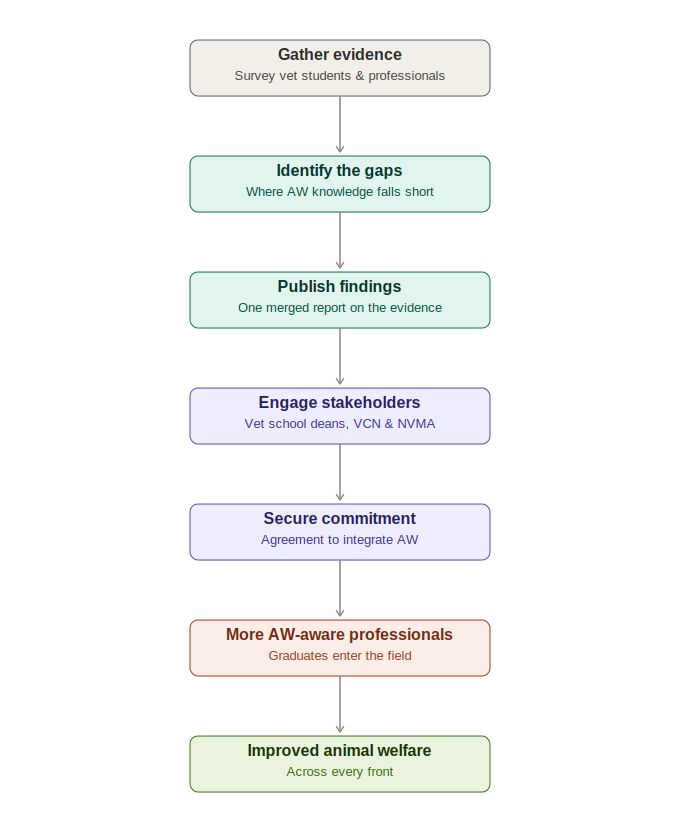
Animal welfare awareness among Nigerian veterinarians is not where it needs to be. Despite years of clinical training, welfare is typically mentioned only in passing rather than taught as a dedicated course or module, leaving a gap in how the next generation of vets is prepared to recognise and act on welfare concerns.
This project is generating the first direct evidence of that gap. Using probabilistic sampling, we're surveying veterinary students at every level across Nigeria's veterinary schools, alongside a concurrent survey of veterinary graduates and practitioners already in the field. The two datasets will be merged into a single report.
The findings will form the basis of direct engagement with the deans of Nigeria's veterinary schools, the Veterinary Council of Nigeria, and the Nigerian Veterinary Medical Association, making the case for animal welfare to be formally integrated into the curriculum.
This project is currently self-funded, supported in part by AFANA's fee-for-service field research work.
Some of our research team's past work
Welfare Awareness in Livestock Transport & Markets
A study on awareness of animal welfare among primary stakeholders during transport and in livestock markets in Nigeria, published in Animal Welfare.
Carbapenemase-Producing Pseudomonas aeruginosa in Sokoto
A study on multidrug-resistant Pseudomonas aeruginosa isolated from patients in Sokoto, Nigeria, contributing to AFANA's wider AMR research focus.
Farmers' Behavioural Drivers for Cattle Welfare
A study evaluating farmers' behavioural drivers for animal welfare in cattle production systems across settlements in Nigeria, currently under peer review.
Help us go further, faster
Every partnership, donation, and connection helps us build a stronger foundation for farmed animal welfare in Nigeria.
Get Involved